
Attending an Advanced Placement Summer Institute (APSI) (Teacher training) last week was an empowering experience, especially as a wheelchair user. The institute focused on AP Environmental Science (APES), which is a course used in High school to give high school students college credits before starting college. I was thrilled to be fully included in the field work, thanks to a golf cart, open minded and solution oriented facilitator and participants that allowed me to navigate the outdoor sites. This post shares my journey and highlights how wheelchair access field work can be inclusive and accessible.
Why APSI Matters for AP Teachers
APSI workshops are essential for teachers to deepen their content knowledge and learn new strategies. For APES, hands-on field work is essential for exploring the environment, gathering specimens and collecting data, but it often poses barriers for educators and students with mobility challenges. My experience showed that with simple accommodations and solution oriented folks inclusion is possible.
Wheelchair Access Field Work in Action
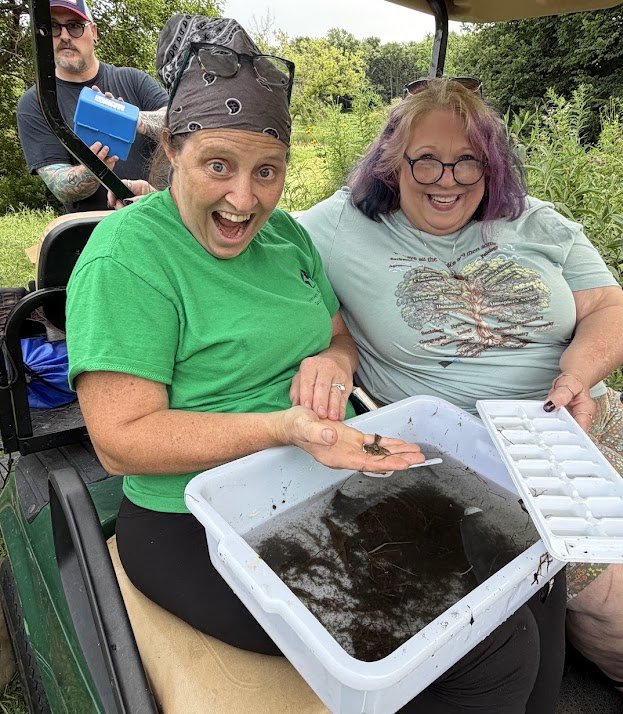
The institute took place at Loyola University Chicago’s LECU campus in Woodstock, with varied terrain. The organizer helped to arranged a golf cart, which we used to travel between sampling sites. I also had a couple of brave volunteers from the other participants help lift me into the cart where there were bars I could hold onto while my instructor drove. I knew how to direct them to lift me safely – for them and me. Understanding my capabilities is a huge key to support others to help me be included – I’m from a small demographic and I can’t expect people to know how to help me so I need to be able to educate! I could not get directly into the ponds which I would have loved to do but the other participants collected bus tubs of water samples with ponds specimens and placed tubs of water on a lap board I always use. This enabled me to get my hands in the water and pick out specimens and see first hand the bio- diversity in the different ponds. I was able to record data and take pictures alongside my peers. The highlight for me was seeing all the stages of how a frog goes through metamorphosis we observed tadpole eggs – tadpoles- 1/2 frog and tadpole (See pic!!) to finally a bull frog. The key was communication: they asked what I needed and made it happen. This is a model for how wheelchair access field work can be integrated into any outdoor education setting.
Adaptations That Made It Work
- Golf cart transportation: Allowed me to move quickly over grass and gravel paths. Its very difficult to traverse through hilly and grassy areas with a wheelchair.
- Accessible sampling: A lapboard to comfortably place the tub of pond samples for observation and specimen collection. Another option could be to bring the wheelchair with- transport out of the golf cart into the wheelchair and then have wheelchair height tables set up for the analysis. This is not ideal if going to multiple areas for investigation- too much transferring takes a toll on everyone involved.
- Peer assistance: Colleagues helped lift me into golf cart and drive because there were no hand controls on the golf cart. They also helped to carry gear and collect pond samples for my analysis. they are helped to return the specimens back to their home.
Overcoming Fear and Learning to Lift
One of the most memorable parts of the APSI was the first day when I needed to get into the golf cart. The group of teachers was super supportive and offered to lift me in. But I had to overcome my fear of being judged, of falling out of the cart, and of someone getting hurt. I took a deep breath and confidently directed them on how to lift me safely. I taught them to come under my knees so they stay bent, and under my armpits while grasping my forearms. I learned these techniques and the importance of proper training during my travels to India with my husband. That moment of trust and teamwork made me feel empowered and included.
Lessons for Event Organizers
If you’re planning a field-based workshop, consider these tips for wheelchair access field work: survey the site for barriers, provide alternative transportation, and have a backup plan for weather. Including participants with disabilities enriches the experience for everyone. For more ideas on inclusive outdoor activities, check out Chicago Adaptive Sports & Disability Events Calendar for community events that prioritize access and trains volunteer how to support people with varying disabilities.
Empowerment Through Inclusion
Being included in the field work boosted my confidence and reminded me that disability does not limit participation. Organizations like Project Awaken champion this message daily, pairing volunteers with individuals to help them re-engage with life. For women facing mobility challenges, products like Easy Access Pants can also remove barriers to outdoor activities by providing discreet, functional clothing.
For more on inclusive education practices, the American Psychological Association offers guidelines on creating accessible learning environments. Remember, wheelchair access field work is not just possible; it’s powerful.
Ready to get active and inclusive? Visit Project Awaken’s events calendar to find accessible outdoor programs near you.
Frequently asked questions
What is an Advanced Placement Summer Institute (APSI)?
An APSI is a professional development workshop for AP teachers, covering curriculum, labs, and teaching strategies for a specific AP course.
How can wheelchair users participate in field work at an APSI?
Organizers can provide accessible transportation like golf carts, ensure pathways are firm and wide, and adapt activities so everyone can engage.
What is AP Environmental Science (APES) field work like?
APES field work often includes water quality testing, biodiversity surveys, and soil analysis outdoors, which can be adapted for wheelchair users.
